Berkeley Lab Finite Element Framework
BELFEM
BELFEM is a special-purpose finite element framework for modeling the electromagnetic and thermal behavior of HTS tapes, the cables wound from them, and the coils and magnets that contain them.
2D Examples
Cross-sectional and planar field solves
These examples cover geometries and physics modeled by BELFEM, from magnet cross-sections to complete 3D cable and coil windings. Every case is solved with the h-φ formulation. Superconducting tapes use thin-shell elements; bulk conductors, iron, and air are meshed as volumes.
HTS Undulator
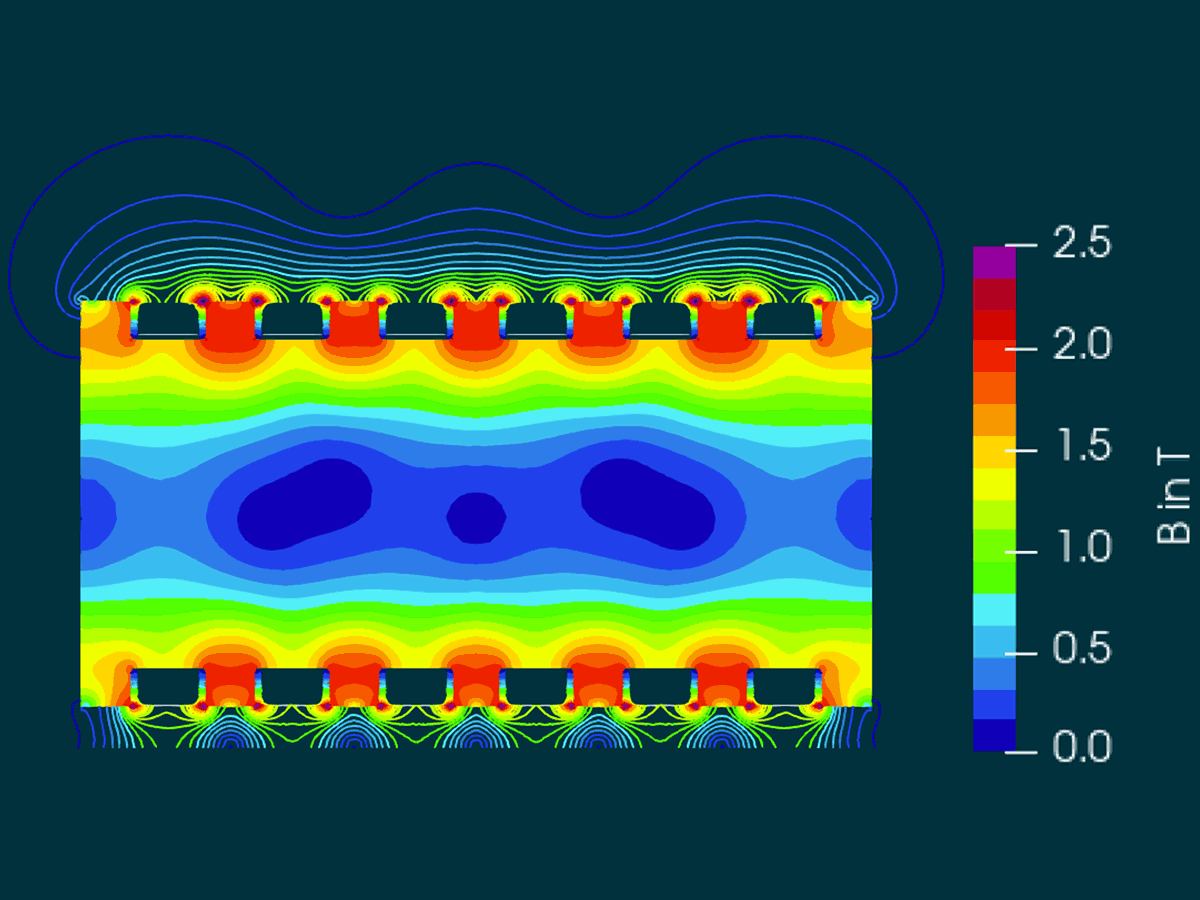
Longitudinal section of a superconducting undulator: two rows of REBCO tape coils on an iron yoke, driven by a user-defined current waveform at 15 K. The plot shows the flux density in the yoke and in the beam gap, where the field alternates along the beam axis.
Cos-Theta Dipole
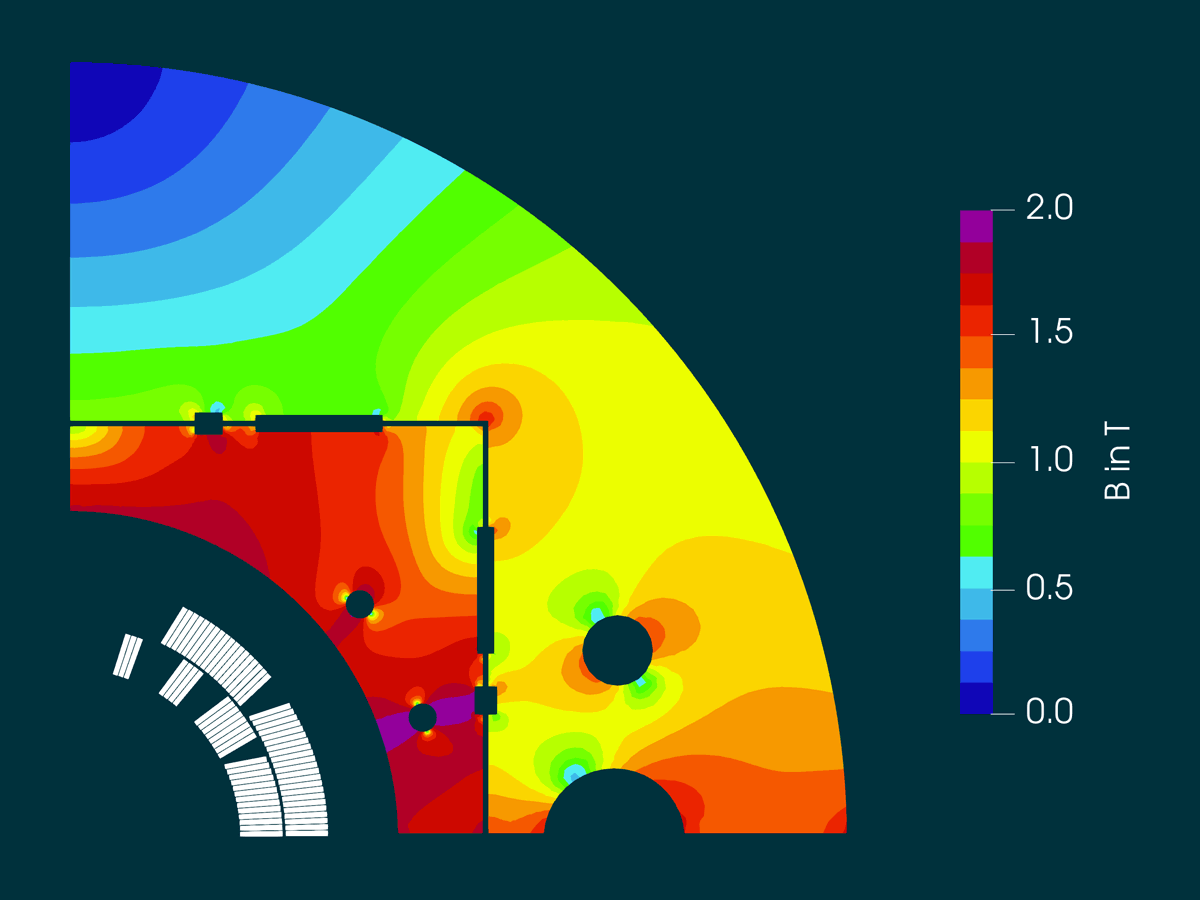
A quarter-section model of a cos-theta dipole contains 68 conductor blocks (outlined at lower left) inside an iron yoke with a nonlinear B-H curve. One symmetry and one antisymmetry plane reduce the magnet to a quarter. The current ramps to 8.5 kA; the plot shows the flux density at full current.
Gantry Magnet
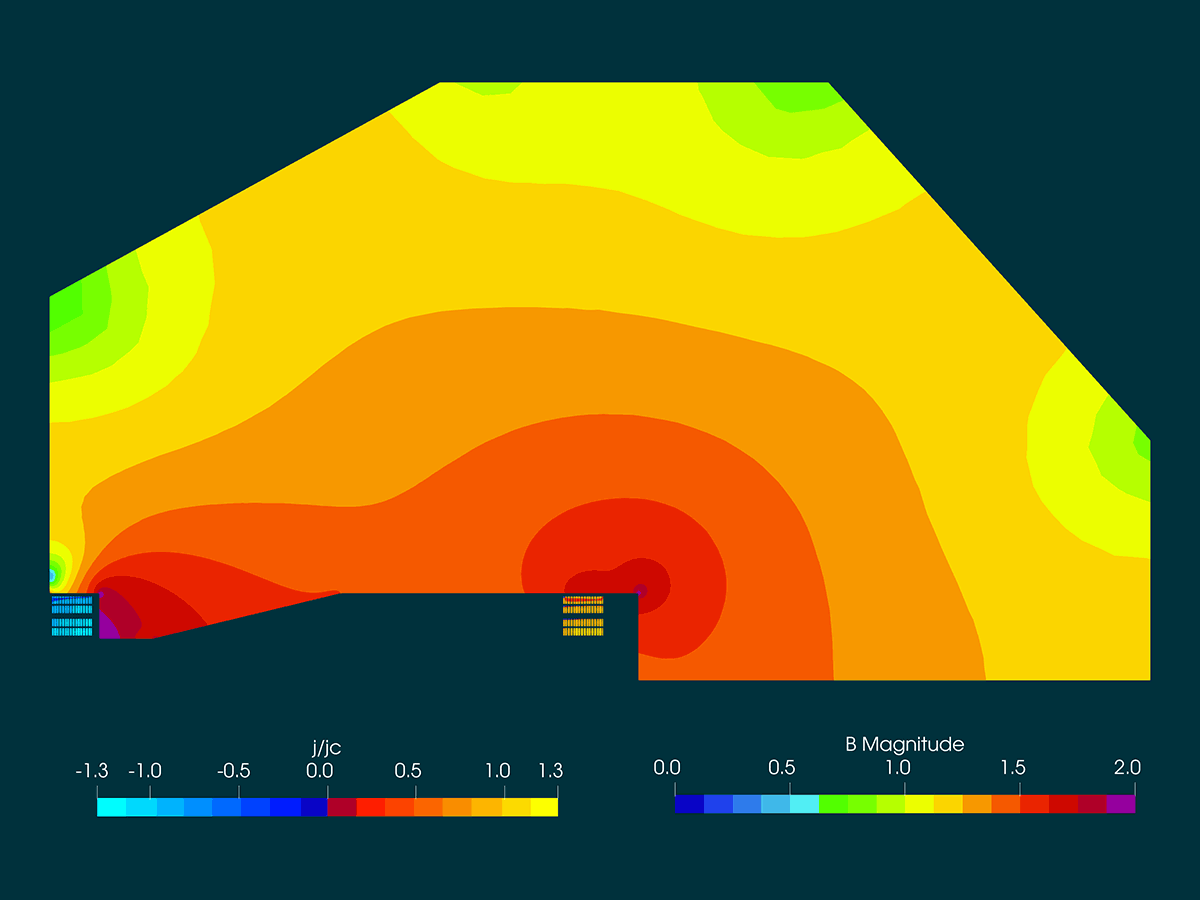
Upper half of a proton-therapy gantry dipole with 464 Bi-2223 thin-shell tapes in its coils and an iron yoke. The plot combines the flux density magnitude in the yoke and aperture with the normalized current density j/jc in each tape.
3D Examples
Full winding and volumetric geometries
CORC® Cable
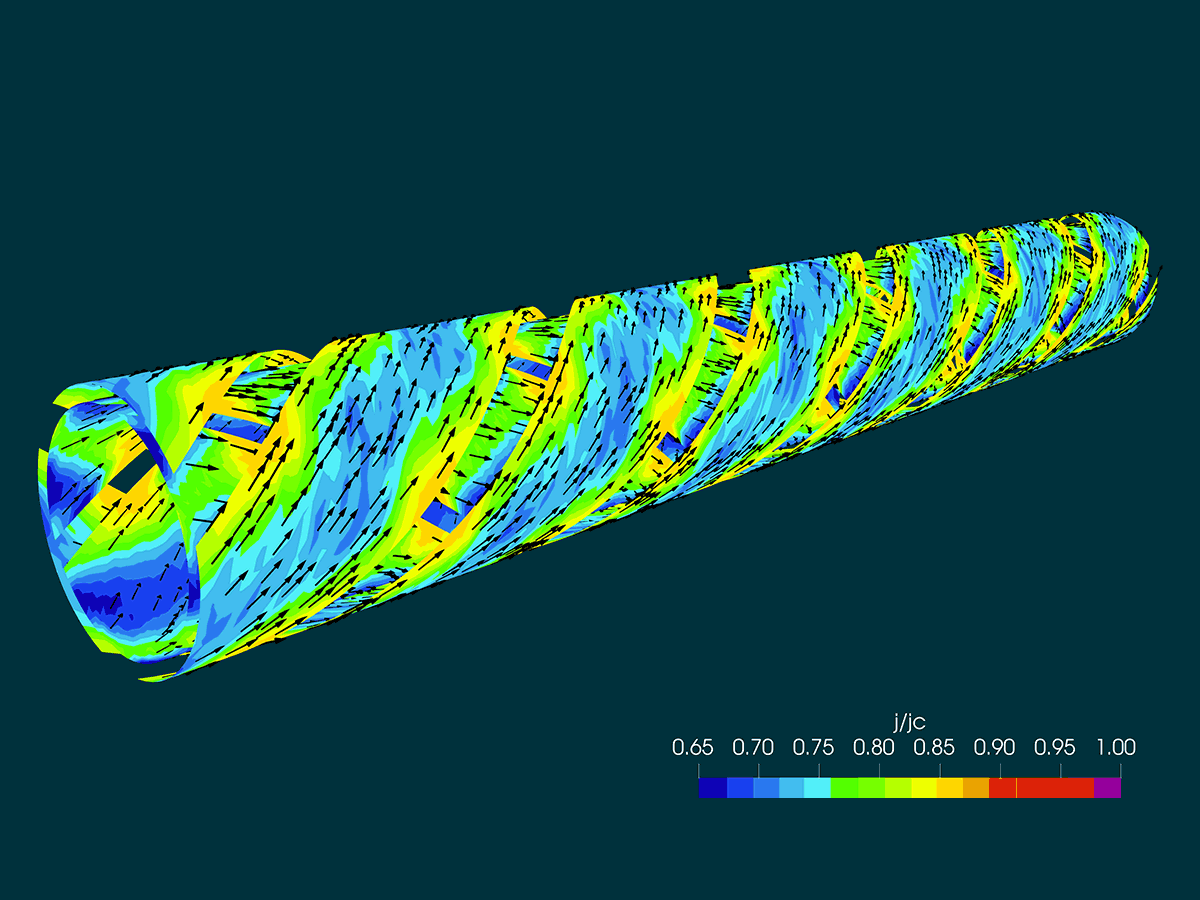
A Conductor on Round Core cable consists of REBCO tapes wound helically around a round core and modeled as thin shells. The plot shows the normalized current density j/jc and its direction along each tape under transport current. A periodic condition over one twist pitch, with translation or twist, represents the infinite cable.
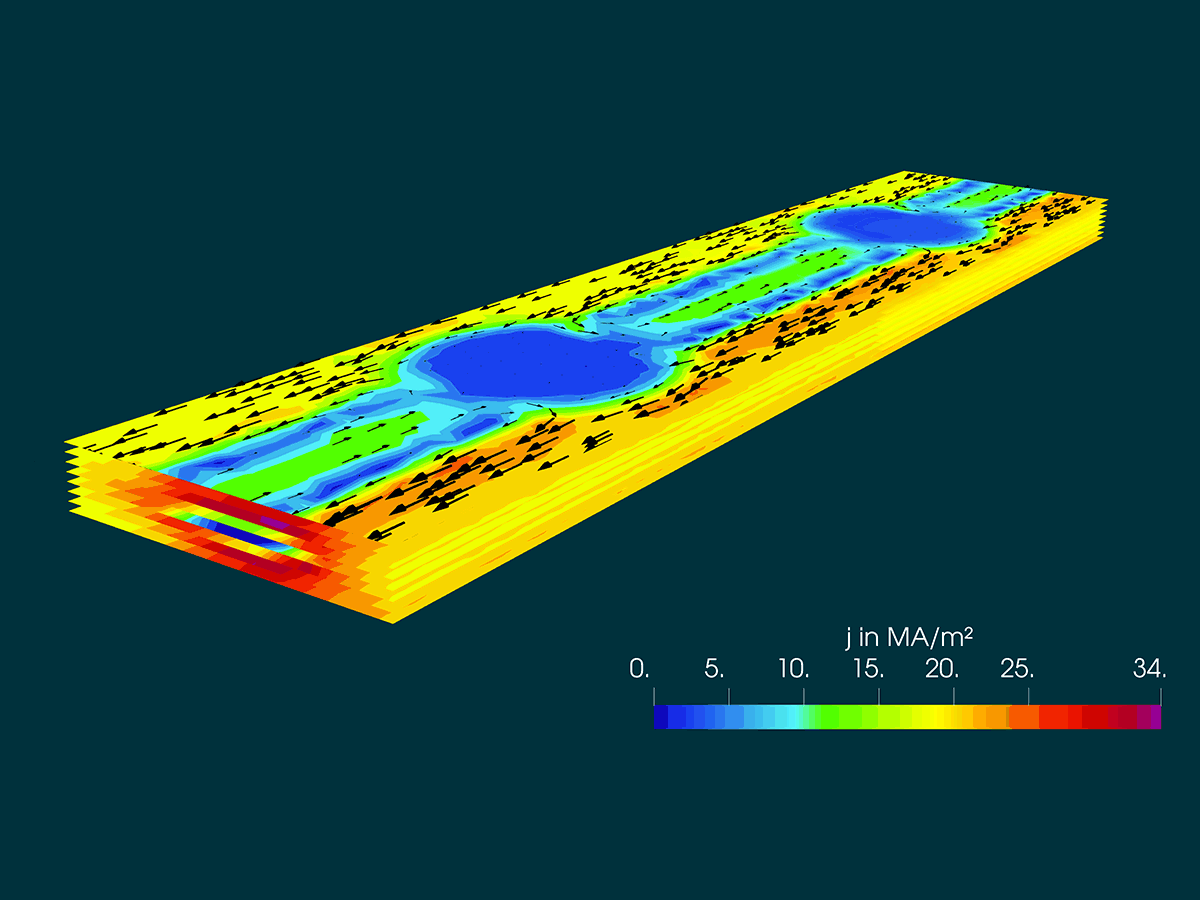
Tape Stack with Defects
A stack of REBCO tapes carries transport current past two local defects. The current density drops in the damaged regions and redistributes into the undamaged width of the tape.
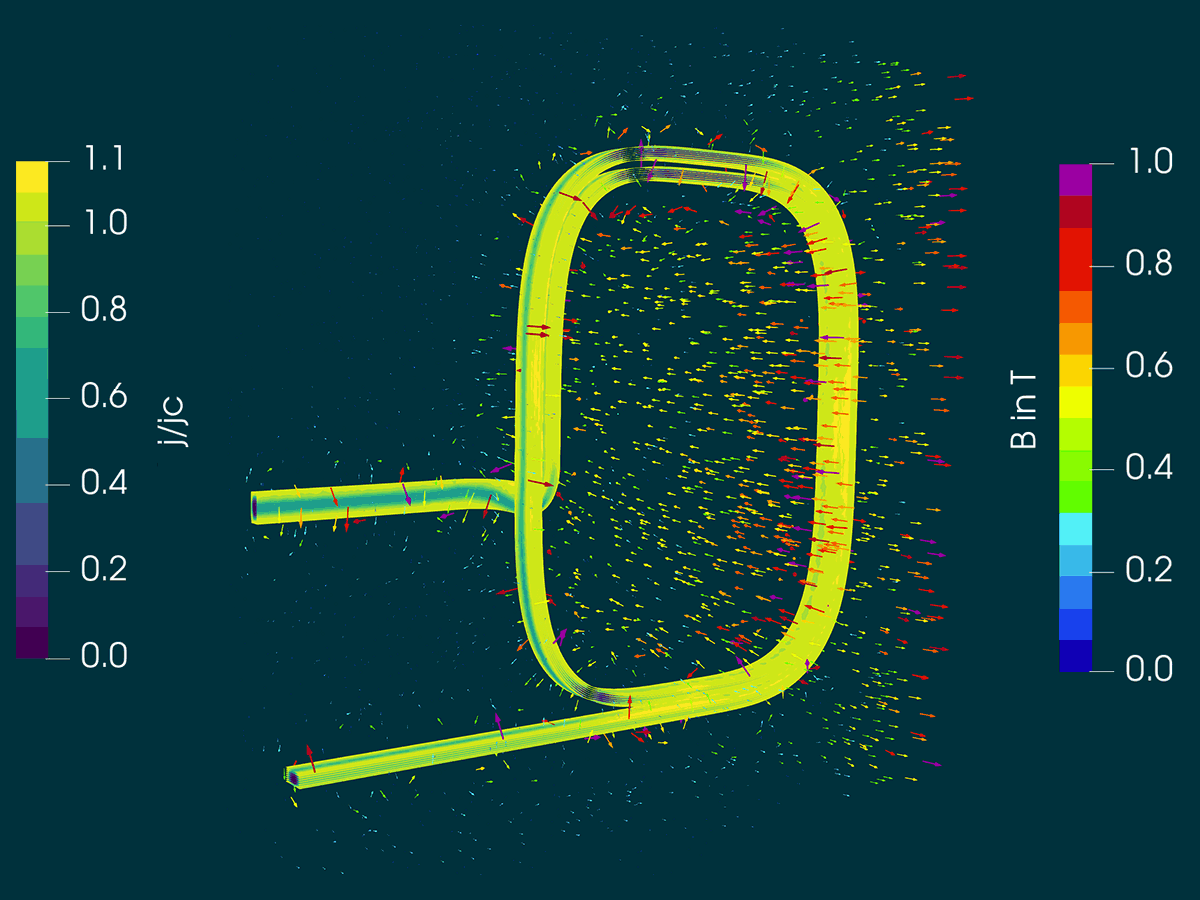
Racetrack Coil
A racetrack coil is wound from a stack of tapes and has two current leads. The normalized current density j/jc varies along the winding, and the arrows show the surrounding flux density.
What It Does
Formulation and physics
BELFEM solves the magnetodynamic h-φ formulation: the magnetic field h is an edge-element unknown in the conducting regions, and a scalar potential φ carries the field through the non-conducting air. Superconducting tapes are far thinner than they are wide, so BELFEM represents them as thin shells whose layers (superconductor, substrate, stabilizer) are resolved inside the shell without a volume mesh of the tape. BELFEM automatically generates the cohomology cuts required by multiply connected conductors from the mesh topology.
In addition to the field problem, BELFEM couples:
- Heat conduction, for quench studies in which a local defect or overcurrent drives part of a tape into the normal state and the hot spot spreads;
- Lumped electrical circuits, either inline RLC networks or SPICE netlists, so a winding can be driven by a source with its own dynamics;
- Nonlinear materials: a critical-current surface jc(B, θ, T) with a power-law resistivity for the superconductor, measured B-H curves for iron, and temperature- and field-dependent properties for the metals;
- Periodic conditions with translation and twist, so one pitch of a helically wound cable represents the infinite conductor;
- User plugins: boundary conditions and sources from your own code or measured data (a current waveform, an applied field), defect functions that modulate jc in space and time, artificial heat loads for quench studies, and complete materials. Each is a shared library compiled against the installed BELFEM API and named in the input deck.
BELFEM is a collaboration between the Berkeley Center for Magnet Technology at Lawrence Berkeley National Laboratory and the Department of Electrical Engineering at Polytechnique Montréal, where the h-φ and thin-shell formulations it implements originate. The publications page lists the papers behind the code.
Materials
Built-in database
BELFEM ships its own material database. Every property is a function of temperature. For the pure metals and alloys the residual resistivity ratio is a free input, and Kohler tables give the resistivity and the thermal conductivity their dependence on both temperature and magnetic field, so a deck states copper with an RRR and gets consistent transport properties from cryogenic to room temperature.
| Pure metals |
- aluminum
- chromium
- copper
- indium
- iron
- lead
- nickel
- silver
- tin
|
|---|
| Solders and alloys |
Mixed by formula from the pure metals, in mass percent, with the RRR of your choice:
Sn60Pb40, In52Sn48, and other soldersFe71Cr19Ni10 and other structural alloys- any other combination of the metals above
|
|---|
| Other materials |
- Hastelloy C-276, the tape substrate
- magnesia (MgO), representing the buffer layer
- YBCO, the superconductor: besides the critical-current model it provides the normal-state resistivity above the critical current and above Tc, together with specific heat, thermal conductivity, and thermal expansion over the whole temperature range, so a quench can be followed through the transition
|
|---|
| B-H curves |
- ROXIE iron, the default curve of CERN's ROXIE code
- SAE 1010
- SAE 310 at 4 K
|
|---|
| HTS conductors |
Measured jc(B, θ, T) and n(B, θ, T) tables from a few kelvin to above 90 K. The REBCO tables are built from the measurements of the Robinson Research Institute's HTS database:
- SuperPower SCS12050-AP
- Shanghai Superconductor high-field tape
- SuperOx
- Fujikura FESC-S12
- Fujikura FYSC-S12
- AMSC Bi-2223
|
|---|
| Superconductor models |
- power-law E-J relation
- piecewise law with the normal-state channel
- parallel power-law/normal-state model (Duron et al. 2004), made total over the full range of the measured tables following Riva
- constant jc and n for quick studies
|
|---|
Every tabulated property is stored as a spline: the conductor tables are quadratic B-splines in temperature, field, and angle, and the metal and B-H curves are splines as well. Their first derivatives are therefore continuous, so the Newton-Raphson iteration sees no jumps in the tangent. That is what lets a nonlinear transient converge cleanly on these materials.
Anything not in the database comes in through a user material plugin, as the racetrack and tape-quench examples in the source tree show.
Built for HPC
Parallel, explicit, tested
BELFEM is written in C++17 with Fortran numerical kernels and runs on distributed meshes with MPI. It links to the major sparse direct solvers (STRUMPACK, MUMPS, PETSc, SuperLU, PARDISO) and to either Armadillo or Blaze as its dense linear algebra backend. Memory management is explicit, with no hidden allocations on the assembly and solve paths, and a test suite ships with the build.
Meshes are generated with gmsh, and results are written in Exodus format for ParaView. BELFEM's numerical dependencies are packaged as SCLS, the Scientific Core Library Stack, so a single package-manager command installs a consistent set of compilers, MPI, BLAS/LAPACK, and solvers.
Availability
Open source since September 2026
BELFEM 0.9.0, the first public release, came out on September 6, 2026 under the Lawrence Berkeley National Laboratory BSD variant (BSD-3-Clause-LBNL). The current version is 0.9.3, released on October 10, 2026. It corrects thin-shell and interface results, among them the conductor-side interface copies, the prism side-face integrals and the automatic gauge pin beside a symmetry plane, corrects several material laws at low temperature and low field, and stops a number of inconsistent inputs during setup with a message; the changelog has the details. The source is available on GitHub, and the rendered documentation covers the input file, the module guides, and the API. The source distribution includes twenty-one input decks covering the cases above, from a two-dimensional dipole that runs in minutes to a coupled magneto-thermal tape stack with periodic boundaries.
To build BELFEM on Linux, you need the C++ compiler that ships with your distribution; CMake, the Fortran compiler, Open MPI, and the numerical libraries come from SCLS. Since 0.9.2, CMake 4.0 is the minimum; a distribution CMake older than that cannot configure BELFEM. On macOS, the GNU toolchain has to be built as well:
tar xf belfem-0.9.3.tar.xz    # or: git clone https://github.com/cmesse/belfem.git
cd belfem-0.9.3 && mkdir build && cd build
cmake .. && make -j8
make check
The GitHub repository carries the released main branch and the release tags.
If you use BELFEM in academic work, please cite Messe et al., BELFEM: a special purpose finite element code for the magnetodynamic modeling of high-temperature superconductor tapes, Supercond. Sci. Technol. 36 (2023), doi:10.1088/1361-6668/acf7f9.